Unknown's avatar

About Julia Gaffield, PhD

Assistant Professor of History, Georgia State University

Hymne Haitiène

I found the “Hymne Haitiène” at the National Archives of the United Kingdom alongside the pamphlet version of the Declaration of Independence (CO 137/111). It was printed at the end of a printed version of Dessalines’s “Journal de Campagne.” The note at the bottom of the page (in Edward Corbet’s handwriting (the British Agent for Affairs in St. Domingo)) reports that it was composed and sung for Dessalines for the first time on 21 January 1804. The song was sung to the tune of the Marseillais.

I am struck by the song’s emphasis on Jean-Jacques Dessalines’s role as unifier of the country; he is able to do this because he is the “father.” Only under his leadership, the song argues, would the country remain free and independent. This theme is repeated in Couplets, performed for Emperor Jacques 1er in November 1804.
20130307-112531.jpg

Continue reading

Couplets, for Emperor Jacques 1er

This song appeared in the Gazette Politique et Commerciale d’Haïti on 22 November 1804. The version I have is from a publication by the Bibliothèque National d’Haïti of the first two years of the newspaper.

photo copy

Continue reading

1804 Census, Gros Morne, Haiti

This brief census report from October 1804 in Gros Morne, Haiti is in the collection at the John Carter Brown Library. It’s an amazing source, and I haven’t seen anything like it for this time period!

There are a number of really interesting features in the document, including the fact that it is a form that was ten years out of date; slavery had been abolished in 1793 but the form has a number of categories for “esclaves,” (the entries for “esclaves” are left blank except for the total population of “Nègres” at the bottom of the reverse).

Continue reading

19 November 1803 Proclamation

This document is from the personal collection of Daniel Supplice. The last time I was in Port-au-Prince, a friend introduced me to Daniel and he kindly let me look at and photograph his collection.

This document, dated 27 Brumaire an XII, Au Cap (19 November 1803 – the date of the evacuation of the French from Le Cap), contains part of the longer proclamation discussed by David Geggus in his post on its publication in The Times, London.

Continue reading

The 29 November 1803 declaration of independence (post by David Geggus)

This is the controversial 29 November 1803 declaration of independence as it appeared in English translation in London in the 6 February 1804 edition of The Times. This was a month after its first appearance in the United States. It thus circulated more quickly than did the 1 January declaration. Sailing times to the US and Europe were shorter from Fort Dauphin, where it was drawn up, than from Port-au-Prince. And as it probably was distributed in manuscript, it was not delayed by the need for a printer. The January declaration did not appear in The Times until 28 April 1804 (and the third section not until May 21). This appears to be the version used in Rainsford. It presumably arrived on a slow merchant ship, whereas the copy Julia Gaffield found that reached London via Jamaica on March 10 no doubt came on the packet boat.

Continue reading

150 Years Later

Erin Zavitz’s post reminded me of a document that Patrick Tardieu shared with me a few years ago. It seems as though the Haitian government was not successful in finding a document in 1903 since they were still looking for it for the celebration of the 150th anniversary of independence. On Dec 31, 1952 Edmond Mangones wrote to La Commission des Sciences Sociales du Tricinquantenaire de l’Independance (The Commission of Social Sciences for the 150th Anniversary of Independence) to report on an original of the Acte de l’Independance and “ce que je pense au suject de sa disparition” (what I think on the subject of its dissapearance). Both the 1903 (from Zavitz’s post) and the 1952 reports suggest that a document might exist in the British Library/Museum (although neither could find one) but the printed versions that I found were at The National Archives of the United Kingdom. Mangones appears to be looking for a handwritten and signed original. Has anyone looked for versions in the British Library?

Continue reading

The Declaration of Independence in Rainsford

Below are images of the Haitian Declaration of Independence from Marcus Rainsford’s 1805 An Historical Account of the Black Empire of Hayti from the collection at the John Carter Brown Library. Paul Youngquist and Gregory Pierrot have recently published an edited version of Rainsford’s book.

Continue reading

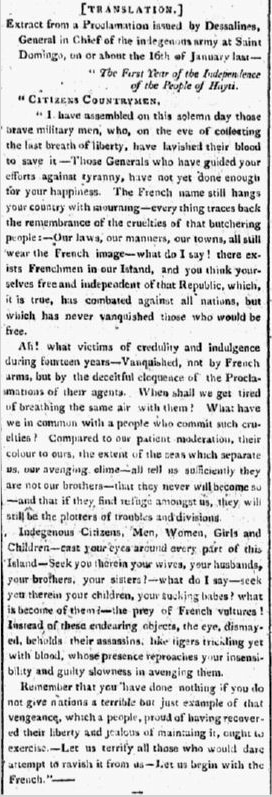
First Publication of the Acte D’Independance in an American Newspaper

According to Deborah Jenson’s research, this is the first publication of part of the Declaration of Independence in any American newspaper. See: Deborah Jenson, “Dessalines’s American Proclamations of the Haitian Independence,” Journal of Haitian Studies, (2009) 15(1): 89.

Evening Post - March 7

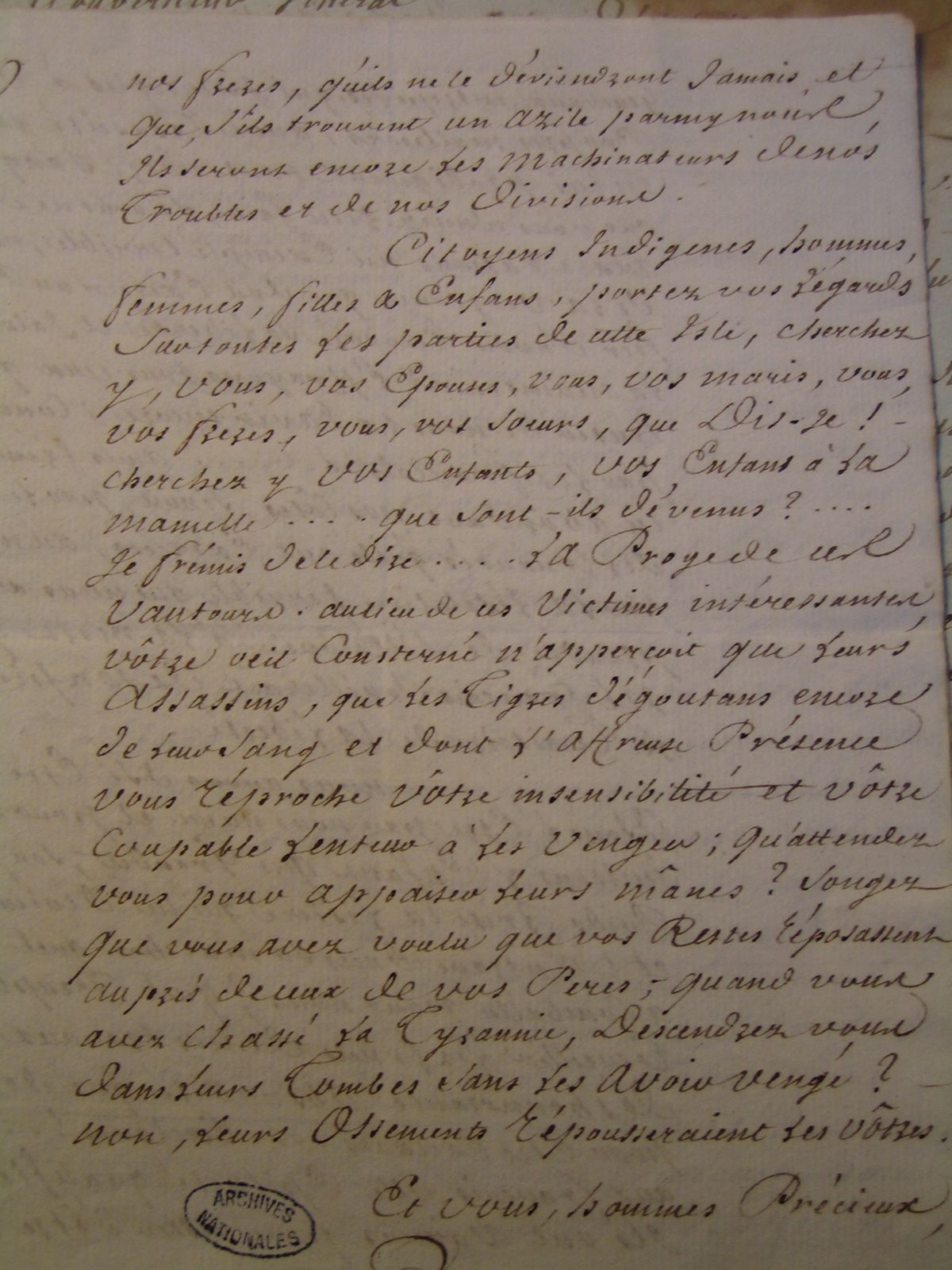
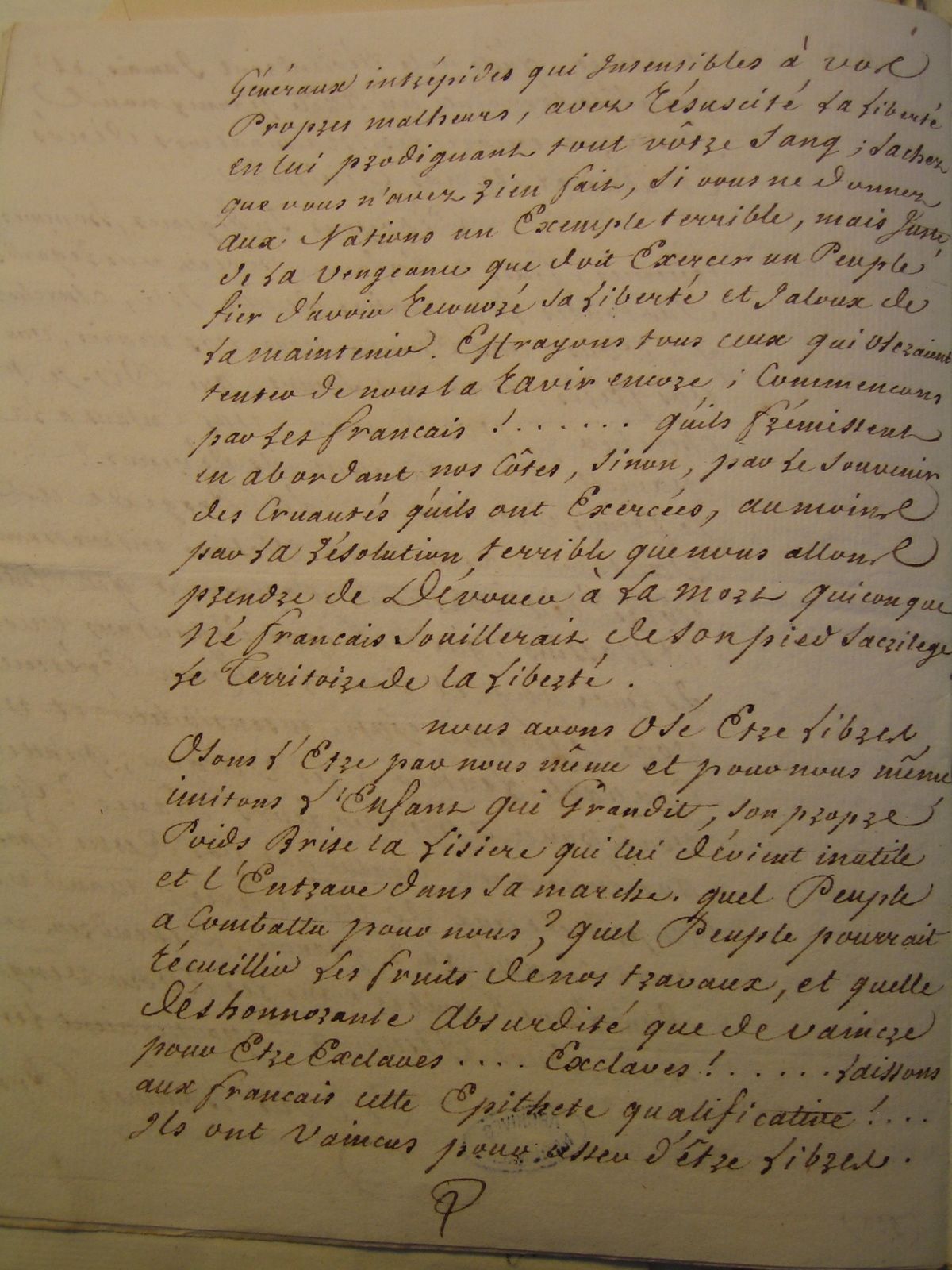
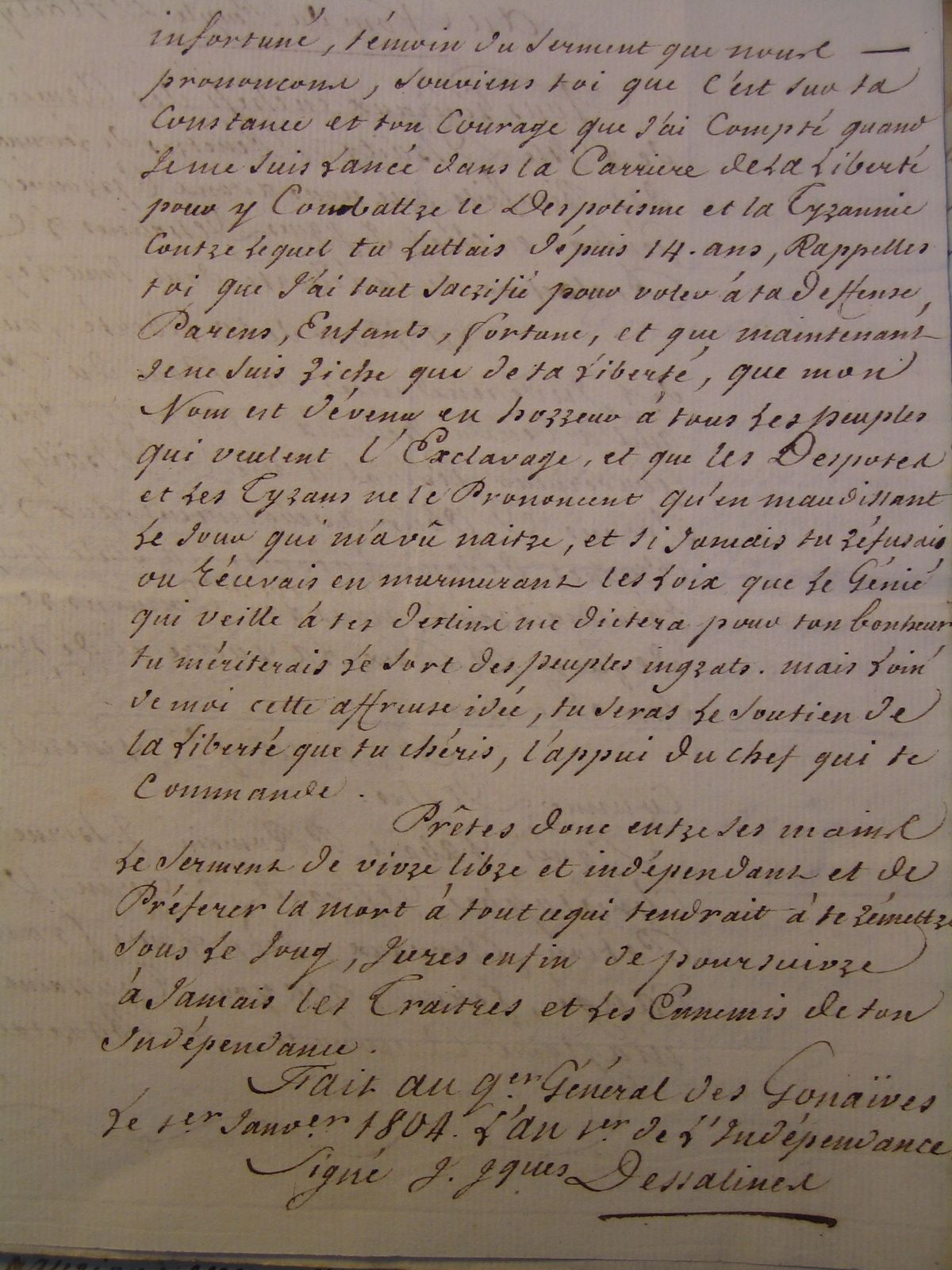
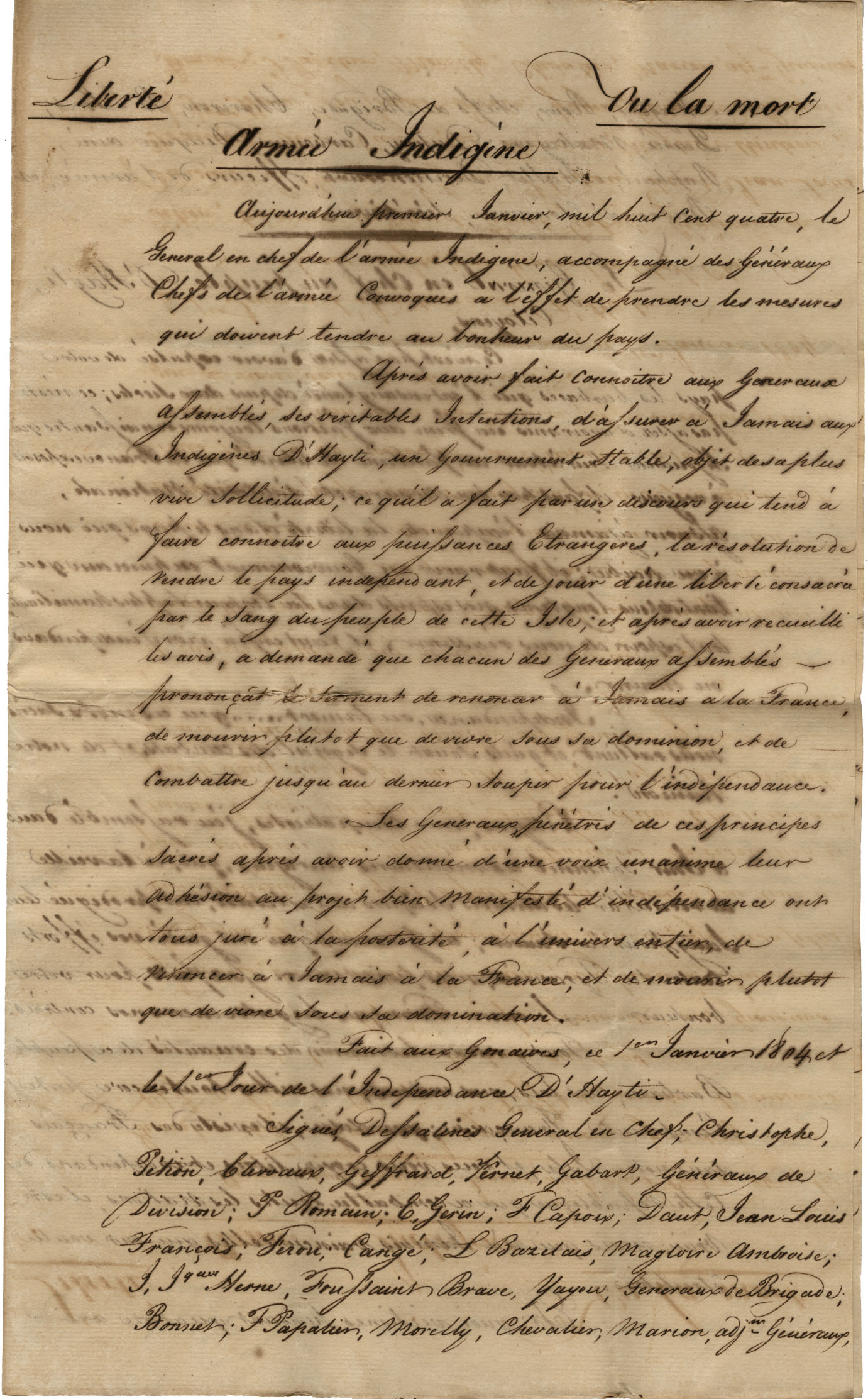
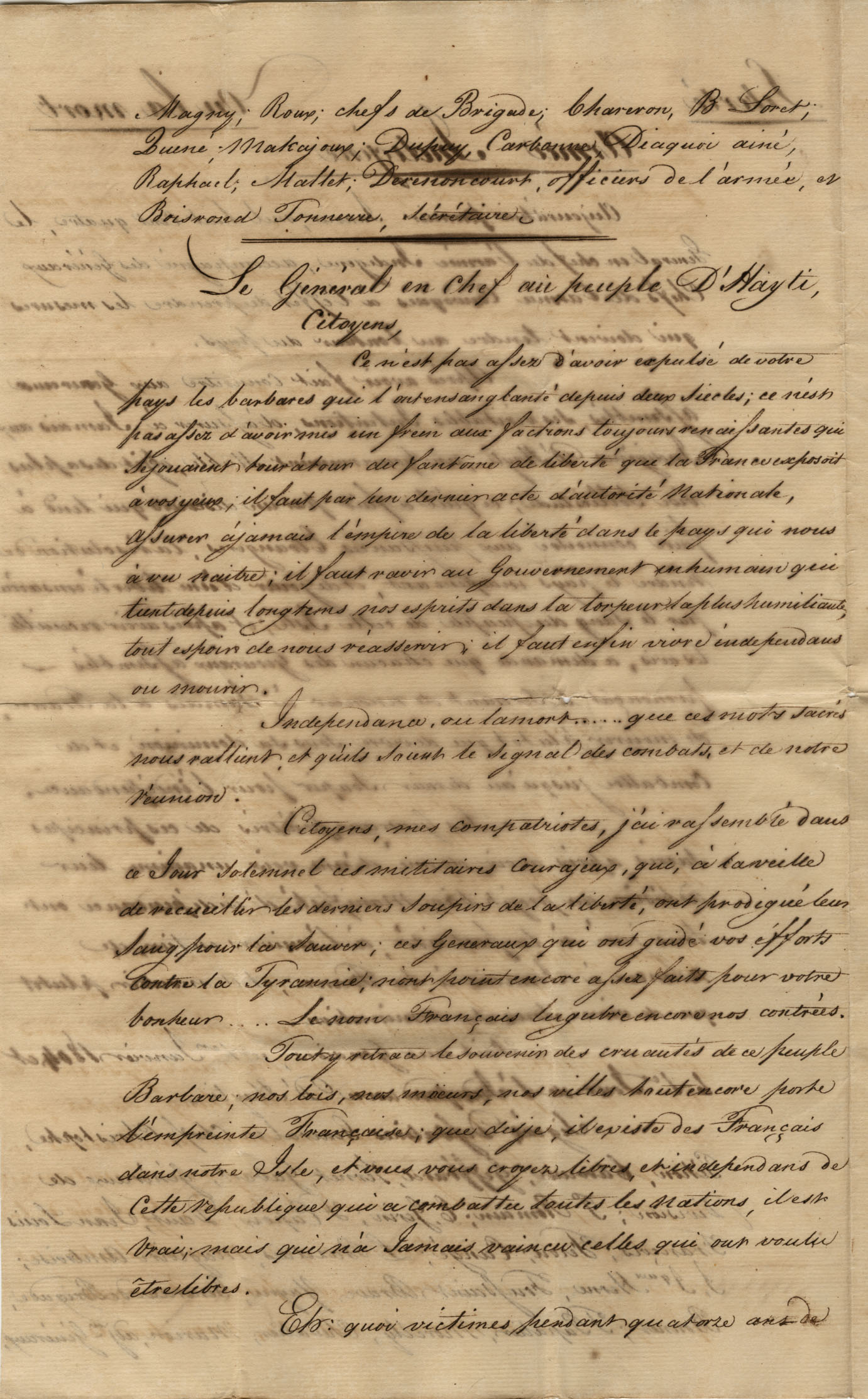
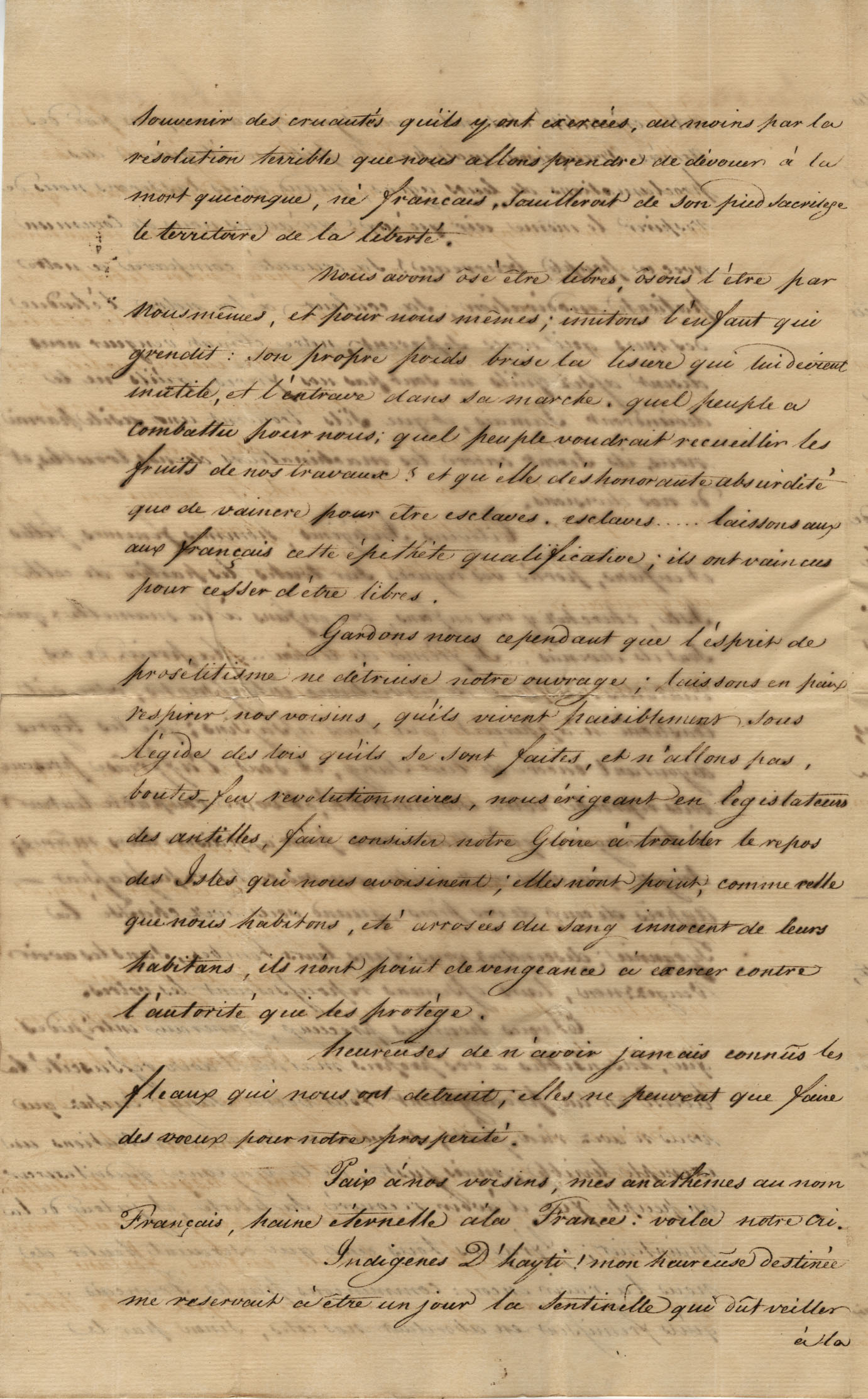
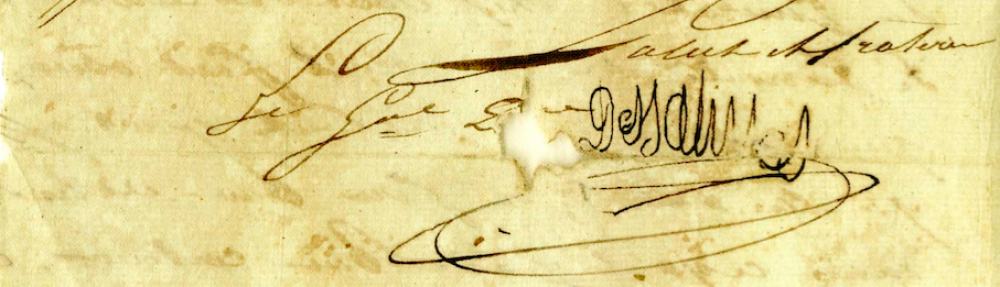
Transcription of the Declaration of Independence at the Archives Nationales, Paris

IMG_1067 IMG_1068 IMG_1069 IMG_1070 IMG_1071 IMG_1072 IMG_1073 IMG_1074

This document is at the Archives Nationales in Paris. Thank you to Silyane Larcher for taking the pictures! The call number is AB/XIX/3302/15.

Transcription at the National Library of Jamaica

page 1 page 2 page 3 page 4 page 5 page 6 page 7

This document is a transcription of the Declaration of Independence from the records of Governor George Nugent of Jamaica. It is at the National Library of Jamaica in Kingston. In a conversation with Deborah Jenson, we concluded that because of this document, along with the cover letter that mentioned that the enclosed document had arrived from a press, somewhere in the Jamaican records there might be a printed copy of the Declaration of Independence. The call number is MS 72.