Jean-Jacques Dessalines to Victor Emmanuel Leclerc, 8 Fructior, an 10, MS Haiti 71-4, Boston Public Library. Continue reading
Dessalines Reader, 8 Fructior, an 10
Reply
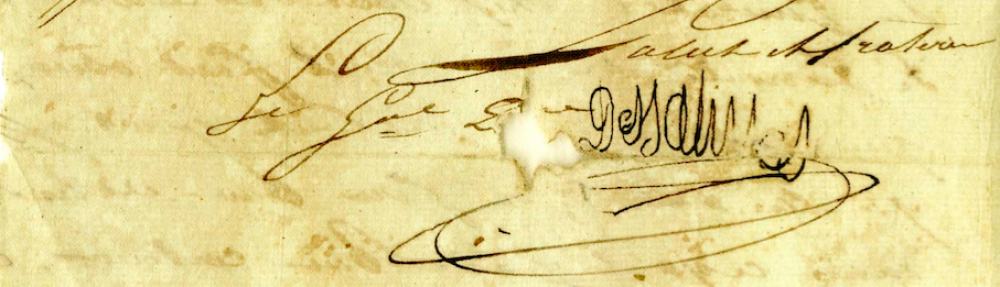

Jean-Jacques Dessalines to Victor Emmanuel Leclerc, 8 Fructior, an 10, MS Haiti 71-4, Boston Public Library. Continue reading
Jean-Jacques Dessalines, “Brevet,” 15 February 1804, MS Haiti 70-21, Boston Public Library. Continue reading
Jean-Jacques Dessalines to Rochambeau, 10 Prairial, an 10, MS Haiti 67-8, Boston Public Library. Continue reading
Jean-Jacques Dessalines to L.M. Desneiver[?], en chef a Jérémie, le 25 Floréal, an [unknown], National Library of Jamaica. Continue reading
Jean-Jacques Dessalines to Donatien Rochambeau, 23 Messidor, an 10, MS Haiti 66-102 (10), Boston Public Library.
My book, Haitian Connections in the Atlantic World: Recognition after Revolution will be out in October 2015! I am super excited and a lot of this has to do with the awesome cover designed by the marketing department at the UNC Press (with a little help from me!).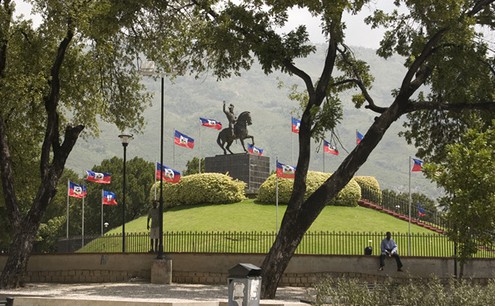
The following is an entry on Dessalines that I wrote for the Dictionary of Caribbean and Afro-Latin American Biography. I hope it’s helpful for anyone teaching the Revolution–comments, corrections, and additional information are most welcome!

After the evacuation of the French troops from the western side of the island at the end of 1803, a small contingent of French soldiers, under the leadership of Jean-Louis Ferrand, fled to the city of Santo Domingo on the eastern side of the island. Since the evacuation agreement signed by the French general Donatien Rochambeau and the General-in-Chief of the Armée Indigène Jean-Jacques Dessalines did not explicitly state that the French relinquished control of the colony, Ferrand and his troops claimed to be the legal authorities for the entire island. Ferrand tried to convince foreign government representatives to prohibit trade with Haiti and enforced his own prohibition of trade with French and Spanish privateers. On February 5, 1805, he issued the Ordinance below that punished anyone caught trading with the “revolted of Saint-Domingue” with death. My research has shown–especially in the case of St. Thomas (a Danish colony) and Curaçao (a Dutch colony)–that governors were reluctant to support Ferrand’s prohibition on trade. Furthermore, even after they conceded and prohibited the trade, the prohibition was only loosely enforced.[1] This Ordinance, however, was publicized in both colonies and this copy is from the Danish National Archives.
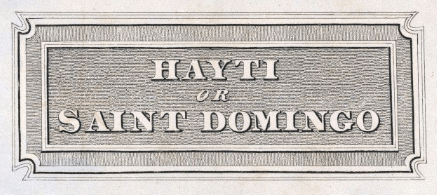
The issue of naming in Haiti and the recognition or non-recognition of that name is something that I’ve been thinking about for a few years now. David Geggus wrote a great chapter called “The Naming of Haiti” in his book Haitian Revolutionary Studies. While undertaking my dissertation research, I was struck by the continued use of “Saint-Domingue” or “St. Domingo” by foreigners when they were referring to the territory that Jean-Jacques Dessalines and his generals had renamed “Hayti.” I wrote a short piece in the French journal Riveneuve Continents called “Identif[ying] the Island in its new situation”: The struggle for Hayti to overcome St. Domingo.” In this article I argued “Not only did the name ‘Hayti’ represent a break from France and a return to a time before colonialism, but the people assumed the roles of the rightful residents of the island. Natives; the land was theirs.” While I was a fellow at the John Carter Brown Library in 2013, I gave a talk and used map titles to illustrate the point that I was making about the uncertainty about Haiti’s status after 1804 and the resistance to fully recognize Haiti’s independence. The map titles that I studied suggest that international mapmakers were slow to adopt “Haiti” or “Hayti” as the name for the territory and only began to do so around the time that France officially recognized Haitian independence (1825). Even then, however, many maps continued to use the colonial name in addition to the new name.
The surviving character descriptions and images of Jean-Jacques Dessalines differ drastically but most tend to portray him in a negative light. In recent years, however, a more complicated picture is beginning to emerge of Dessalines as a person, a military general, and a political leader. “Best known for his military brilliance and his violence against French planters in the wake of independence,” Laurent Dubois argues, “he deserves as much attention for his rhetorical and ideological interventions as well as his determined and skillful diplomatic negotiations with foreign powers.”[1] Foreign observers were not usually kind in their descriptions of him and they emphasized his alleged ferocity and his illiteracy. Deborah Jenson has recently argued that we need to rethink the claims that Dessalines was born in Saint-Domingue since the earliest first-person accounts all describe him as “Bossale” or “African.”[2] There is still a great deal to be learned about Dessalines and I am hopeful that Madison Smartt Bell’s forthcoming biography will help fill in some of the gaps.
Here, I am attempting to collect as many images of Dessalines as possible (and will arrange them in chronological order) to see if any kind of patter emerges. Please send images or links to images if you have them! (I am sure that there are more than the ones below – I couldn’t find source information for some of the images floating around online).
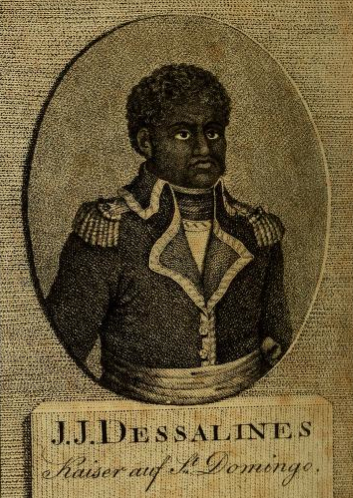
Dubroca, Leben des J.J. Dessalines, oder, Jacob’s des Ersten Kaysers von Hayti (St. Domingo), 1804. (German translation).
 Haiti and the Atlantic World