This table comes from an 1805 publication in Paris by M. Wante called Importance de nos colonies occidentales, particulièrement de celle de Saint-Domingue.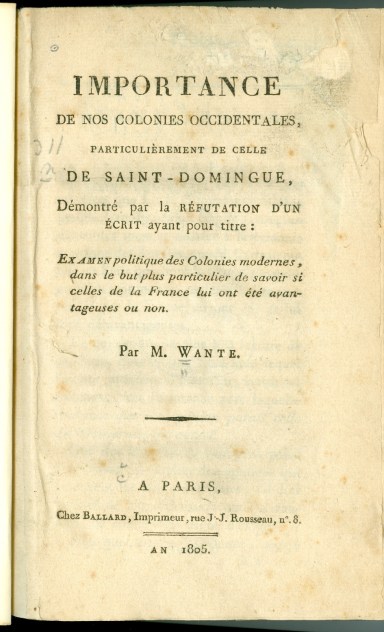
European Imports from the Colonies, 1789
1
This table comes from an 1805 publication in Paris by M. Wante called Importance de nos colonies occidentales, particulièrement de celle de Saint-Domingue.
I first saw this map in 2008 when I took my first research trip to Paris. It is at the Richelieu branch of the Bibliotheque Nationale (you can also see it online at Gallica). This is one of those sources that doesn’t really fit with my research project, but I really like it anyway. The watercolor painting is just beautiful! Does anyone know about this battle? Or if it even happened (the painting might be a hypothetical!).

In the 2011 issue of the Journal of Haitian Studies, Duke Professor Jacques Pierre published a Kreyol translation of the Acte d’Indépendance. Jacques has been working hard to change the historic tendency in Haiti to favor French over Kreyol (see, for example, his op-ed in The Haitian Times).
I found the “Hymne Haitiène” at the National Archives of the United Kingdom alongside the pamphlet version of the Declaration of Independence (CO 137/111). It was printed at the end of a printed version of Dessalines’s “Journal de Campagne.” The note at the bottom of the page (in Edward Corbet’s handwriting (the British Agent for Affairs in St. Domingo)) reports that it was composed and sung for Dessalines for the first time on 21 January 1804. The song was sung to the tune of the Marseillais.
I am struck by the song’s emphasis on Jean-Jacques Dessalines’s role as unifier of the country; he is able to do this because he is the “father.” Only under his leadership, the song argues, would the country remain free and independent. This theme is repeated in Couplets, performed for Emperor Jacques 1er in November 1804.

This song appeared in the Gazette Politique et Commerciale d’Haïti on 22 November 1804. The version I have is from a publication by the Bibliothèque National d’Haïti of the first two years of the newspaper.

This brief census report from October 1804 in Gros Morne, Haiti is in the collection at the John Carter Brown Library. It’s an amazing source, and I haven’t seen anything like it for this time period!
There are a number of really interesting features in the document, including the fact that it is a form that was ten years out of date; slavery had been abolished in 1793 but the form has a number of categories for “esclaves,” (the entries for “esclaves” are left blank except for the total population of “Nègres” at the bottom of the reverse).
This document is from the personal collection of Daniel Supplice. The last time I was in Port-au-Prince, a friend introduced me to Daniel and he kindly let me look at and photograph his collection.
This document, dated 27 Brumaire an XII, Au Cap (19 November 1803 – the date of the evacuation of the French from Le Cap), contains part of the longer proclamation discussed by David Geggus in his post on its publication in The Times, London.
This is the controversial 29 November 1803 declaration of independence as it appeared in English translation in London in the 6 February 1804 edition of The Times. This was a month after its first appearance in the United States. It thus circulated more quickly than did the 1 January declaration. Sailing times to the US and Europe were shorter from Fort Dauphin, where it was drawn up, than from Port-au-Prince. And as it probably was distributed in manuscript, it was not delayed by the need for a printer. The January declaration did not appear in The Times until 28 April 1804 (and the third section not until May 21). This appears to be the version used in Rainsford. It presumably arrived on a slow merchant ship, whereas the copy Julia Gaffield found that reached London via Jamaica on March 10 no doubt came on the packet boat.
My favorite image of Haitian independence is a 1999 painting by the great Haitian artist Ernst Prophète, now in the private collection of Jack Rosenthal and Holly Russell (New York City). A representative of the “naïf” style, Prophète’s great work shows Dessalines at the center of a group of generals, standing on a stone platform in the town square of Gonaïves, reading the text of his January 1 address to a throng of cheering Haitians, their hands raised triumphantly above their heads in pride and joy. To the right, Prophète depicts a group representing the free people of color of Saint-Domingue, their reaction to the announcement somewhat obscured by the leaves of the palm trees that tower above the crowd and gesture to the seascape that lies beyond.
My paper for this conference explores the ways in which the archive of Vodou song references and engages with the experience of Haitian independence. The two videos below provide some examples. In the first, an interview done in November 2012 by Duke students Claire Payton and Eric Barstow as part of the Vodou Archive project, the head of the Lakou Badjo recounts the story of its founding and its links with Dessalines’ role in the war of independence.
 Haiti and the Atlantic World