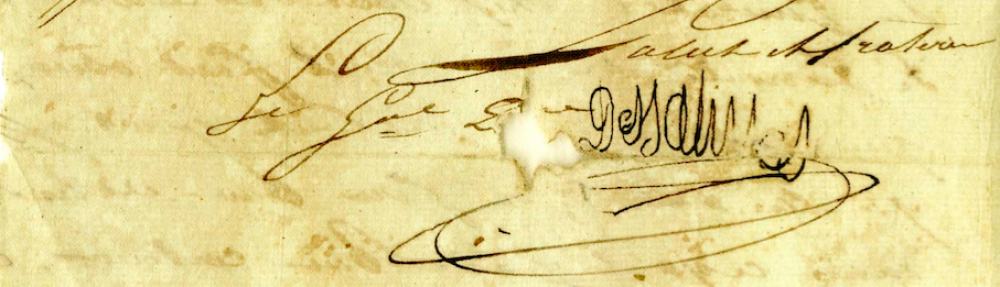
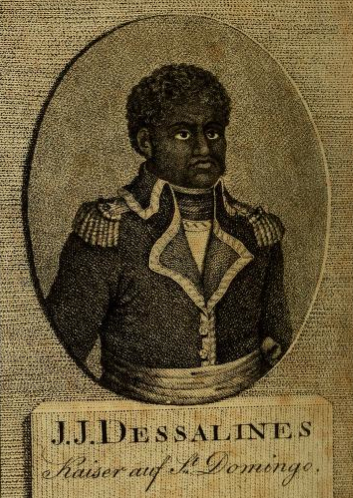
Jean-Jacques Dessalines

The surviving character descriptions and images of Jean-Jacques Dessalines differ drastically but most tend to portray him in a negative light. In recent years, however, a more complicated picture is beginning to emerge of Dessalines as a person, a military general, and a political leader. “Best known for his military brilliance and his violence against French planters in the wake of independence,” Laurent Dubois argues, “he deserves as much attention for his rhetorical and ideological interventions as well as his determined and skillful diplomatic negotiations with foreign powers.”[1] Foreign observers were not usually kind in their descriptions of him and they emphasized his alleged ferocity and his illiteracy. Deborah Jenson has recently argued that we need to rethink the claims that Dessalines was born in Saint-Domingue since the earliest first-person accounts all describe him as “Bossale” or “African.”[2] There is still a great deal to be learned about Dessalines and I am hopeful that Madison Smartt Bell’s forthcoming biography will help fill in some of the gaps.

Here, I am attempting to collect as many images of Dessalines as possible (and will arrange them in chronological order) to see if any kind of patter emerges. Please send images or links to images if you have them! (I am sure that there are more than the ones below – I couldn’t find source information for some of the images floating around online).
Continue reading

The Samaná Affair

I recently visited the Schomburg Center for Research in Black Culture for the first time. I could try to describe the elation I felt, sitting in the reading room under the auspices of Aaron Douglass’ Aspects of Negro Life murals, but listening to poet and activist Sonia Sanchez tell the story of her first visit to the library will give a better sense of what the Center has long represented for black culture and history.  I will turn instead to what the Schomburg Center holds that might be of interest more specifically to scholars of the Haitian Revolution.

The Schomburg Center is home to extensive archival collections related to Haiti. Lately I have been working on King Henry I, and I have to say that the Kurt Fischer Archive–the exploration of which I devoted this first visit–has very little in connection to the Kingdom of Haiti. However, it has much to offer regarding the Southern Republic. Perusing through those documents, I found out about the  Samaná affair, a peculiar episode regarding Jean-Pierre Boyer’s annexation of Santo Domingo in 1822.

Continue reading

Haitian Constitutions 1790-1860

Dessalines's 1805 constitution, original at the American Philosophical Society, Philadelphia

Dessalines’s 1805 constitution, original at the American Philosophical Society, Philadelphia

Laurent Dubois (@soccerpolitics), Michel Acacia, and I edited a publication on Haitian constitutions that was part of a series called The Rise of Modern Constitutionalism, 1776-1849. What is awesome about this project, is that all of the Haitian (and Dominguan) constitutions and amendments between 1790 and 1860 are available on their website! You can see images of the originals that are held in diverse archives around the Atlantic. What is not so awesome about the website is that our introduction (in English and French) is not available online. You might be able to get it through ILL, the title is Documents constitutionnels d’Haïti 1790-1860, edited by Laurent Dubois, Julia Gaffield, Michel Acacia ; in cooperation with Matthias Schneider.

Continue reading

Translations of the HaitiDOI

I have been able to find the Haiti DOI in 5 languages (with the help of HaitiDOI guest author Mitch Fraas @MitchFraas)! I will update the list as I (or you!) find more.

French – the original Haiti DOI is in French, you can read it here or here.

English – there are many English translations of the Haiti DOI. I wrote a post about a translation from 1804. John Garrigus and Laurent Dubois published a translation in their book Slave Revolution in the Caribbean, 1789-1804.

Continue reading

The Haitian Coat of Arms

I recently had a conversation with Dr. Richard Rabinowitz, founder and president of the American History Workshop, about the Haitian coat of arms. We were discussing when it was first created; I checked my records and I couldn’t find any use of it before 1818 (since my original post, I’ve found another document with Henry Christophe’s coat of arms from 1816 – see below). Many sources cite Alexandre Pétion as the creator of the design that features a palm tree topped with a phrygian cap and surrounded by blue and red flags, canons, anchors, and other objects.[1] Laurent Dubois also notes that Pétion included the motto “Unity is our strength” in his version of the coat of arms – the current motto on the flag is “L’Union Fait La Force.”[2] Paul Clammer (@paulclammer) commented on twitter that the Musée du Panthéon Nationale Haïtien (MUPANAH) has a drum from Pétion with the coat of arms painted on the side. I haven’t been able to find a good image of it, though.

The current Haitian coat of arms, taken from Wikipedia.

The current Haitian coat of arms, taken from Wikipedia.

Continue reading

Reporting Haiti’s Independence in British India

As many of the writers for this blog have noted, news of Dessalines’ victory over French forces in November 1803, and the formal Declaration of Independence in January 1804 made newspapers across the Americas and Europe. As a historian of British India, I’m always eager to show how the “Atlantic World” was not always confined to the Atlantic. Commercial, imperial, and family networks linked the Atlantic and Indian Ocean world together from the beginnings of European imperialism and it should be no surprise that readers in British India were kept well-informed of events in Saint-Domingue and then Haiti.

1803DOIHaiti

ColophonBombayCourier Supplement to the Bombay Courier  June 2, 1804 (British Library Newspapers)

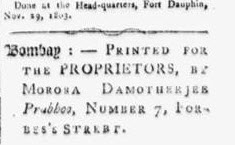
Copies of early newspapers from South Asia are scarce, but Adam Matthew has digitized a large run of microfilmed issues of The Bombay Courier held at the British Library. In these issues one can see how reports from English and American newspapers about the Caribbean trickled into circulation in India. Most relevantly for this blog, in June 1804, the Courier dedicated nearly an entire page of its “Supplement” to reprinting correspondence relating to the capitulation of Rochambeau’s forces the previous November. To close its coverage, the Courier reproduced the November 29th declaration of independence issued at Fort Dauphin. I’m especially taken by this reprinting as it shows nicely the interconnectedness of the early nineteenth-century world – that is, a proclamation of independence issued by an army of African ex-slaves and people of color in French, translated into English, and printed for a reading public thousands of miles away by a Prabhu [1] printer.

Continue reading

Post-independence Cancellation of Plantation Leases

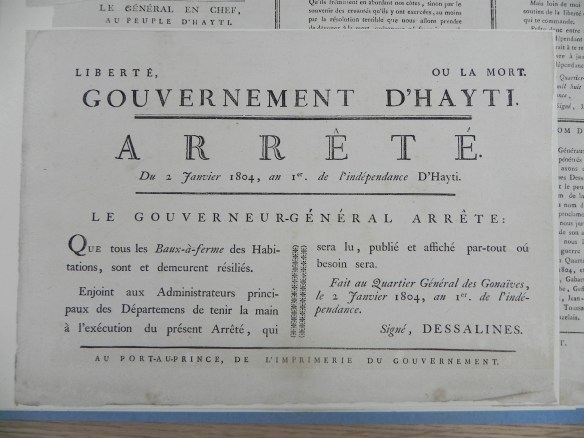
This is another broadside cataloged (TNA, MFQ 1/184) with the Declaration of Independence and I’m not exactly sure what it means. Dessalines cancels all baux-à-ferme (which I think translates as “fixed-term leases” but I’m not completely sure) on plantations. I suspect that this might have been part of a larger move by the state to acquire plantations formerly owned by white French colonists. Although the decree doesn’t explicitly say that the state would confiscate the properties, it eliminates any potential legal challenges to this move. Any other possible interpretations of this decree?

DSCN0612

Continue reading

Post-independence Labor and Migration Restrictions

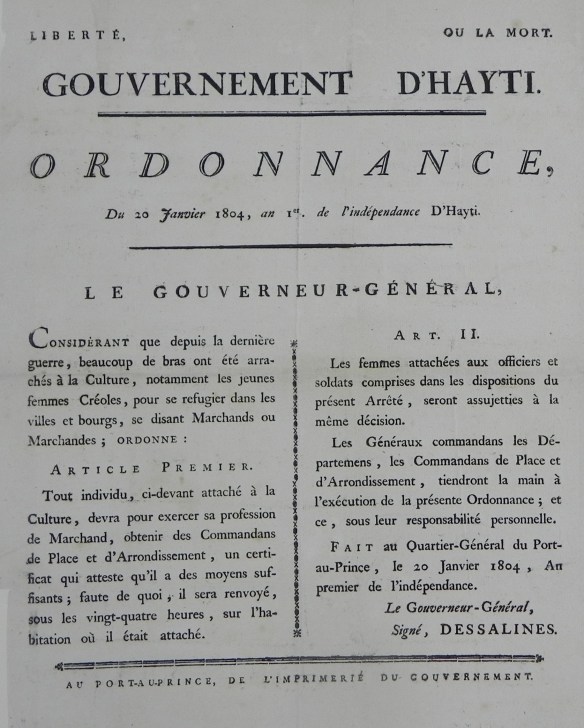
This Ordinance is cataloged with the broadside version of the Declaration of Independence and it sheds light on some of the post-independence restrictions on mobility and plantation labor.

DSCN0611

Continue reading

English Translation of the HaitiDOI

I found this translation of the Haitian Declaration of Independence in the Admiralty Records from the Jamaica Station (ADM 1/254) (it was next to the paper that noted that the broadside copy had been removed and recataloged). I think it’s interesting to read translations like this because it reveals how contemporaries interpreted the text. One interesting translation is of the word “lugubre” that Dessalines and Boisrond-Tonnerre use as a verb in the Declaration of Independence. This translator uses the word “overclouds” although historians have used “haunts,” “overshadows,” or “darkens” (and I’m sure other variations too). Here is the first page along with my transcription of the text.

DSCN0572

I Have Avenged America

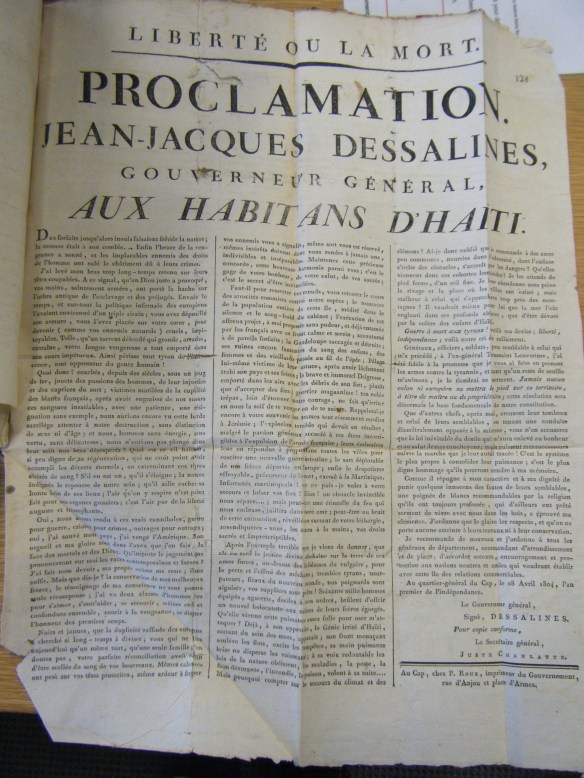
The Haitian Declaration of Independence is characterized by violent rhetoric that brands the French as the eternal enemies of the Haiti. The Declaration also signals that the war against the French is not over since the “the name French overclouds our Country.” To help remedy this barrier obstructing the development of the new nation, Dessalines initiated a series of public executions that targeted white French citizens. The well-known “I have avenged America” speech followed these executions and justified the events. This is a printed copy of the document from The National Archives of the United Kingdom (CO 137-111) and a transcription of a translation of the text from the Connecticut Herald.

DSCF9464

Continue reading