Unknown's avatar

About Julia Gaffield, PhD

Assistant Professor of History, Georgia State University

Haitian Constitutions 1790-1860

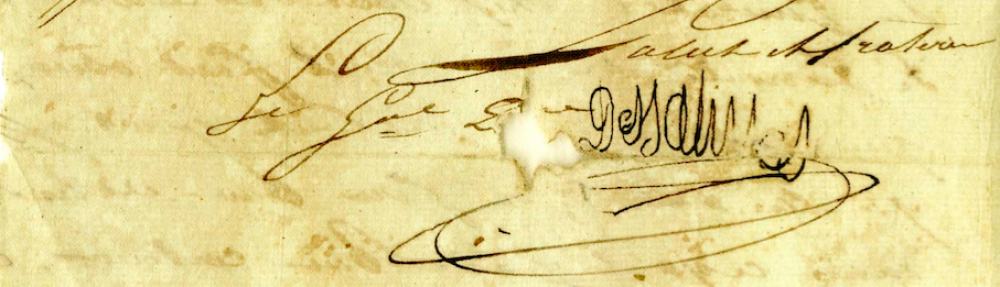
Dessalines's 1805 constitution, original at the American Philosophical Society, Philadelphia

Dessalines’s 1805 constitution, original at the American Philosophical Society, Philadelphia

Laurent Dubois (@soccerpolitics), Michel Acacia, and I edited a publication on Haitian constitutions that was part of a series called The Rise of Modern Constitutionalism, 1776-1849. What is awesome about this project, is that all of the Haitian (and Dominguan) constitutions and amendments between 1790 and 1860 are available on their website! You can see images of the originals that are held in diverse archives around the Atlantic. What is not so awesome about the website is that our introduction (in English and French) is not available online. You might be able to get it through ILL, the title is Documents constitutionnels d’Haïti 1790-1860, edited by Laurent Dubois, Julia Gaffield, Michel Acacia ; in cooperation with Matthias Schneider.

Continue reading

Translations of the HaitiDOI

I have been able to find the Haiti DOI in 5 languages (with the help of HaitiDOI guest author Mitch Fraas @MitchFraas)! I will update the list as I (or you!) find more.

French – the original Haiti DOI is in French, you can read it here or here.

English – there are many English translations of the Haiti DOI. I wrote a post about a translation from 1804. John Garrigus and Laurent Dubois published a translation in their book Slave Revolution in the Caribbean, 1789-1804.

Continue reading

The Haitian Coat of Arms

I recently had a conversation with Dr. Richard Rabinowitz, founder and president of the American History Workshop, about the Haitian coat of arms. We were discussing when it was first created; I checked my records and I couldn’t find any use of it before 1818 (since my original post, I’ve found another document with Henry Christophe’s coat of arms from 1816 – see below). Many sources cite Alexandre Pétion as the creator of the design that features a palm tree topped with a phrygian cap and surrounded by blue and red flags, canons, anchors, and other objects.[1] Laurent Dubois also notes that Pétion included the motto “Unity is our strength” in his version of the coat of arms – the current motto on the flag is “L’Union Fait La Force.”[2] Paul Clammer (@paulclammer) commented on twitter that the Musée du Panthéon Nationale Haïtien (MUPANAH) has a drum from Pétion with the coat of arms painted on the side. I haven’t been able to find a good image of it, though.

The current Haitian coat of arms, taken from Wikipedia.

The current Haitian coat of arms, taken from Wikipedia.

Continue reading

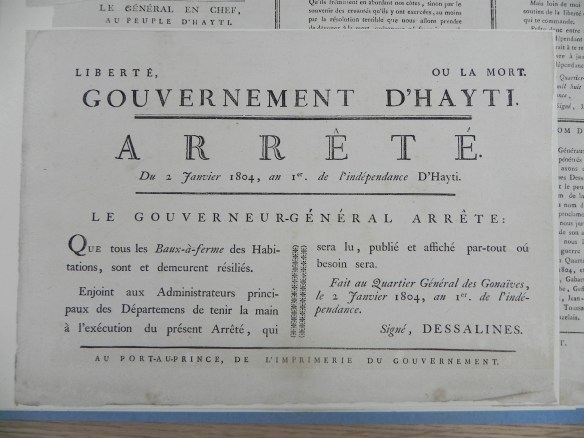
Post-independence Cancellation of Plantation Leases

This is another broadside cataloged (TNA, MFQ 1/184) with the Declaration of Independence and I’m not exactly sure what it means. Dessalines cancels all baux-à-ferme (which I think translates as “fixed-term leases” but I’m not completely sure) on plantations. I suspect that this might have been part of a larger move by the state to acquire plantations formerly owned by white French colonists. Although the decree doesn’t explicitly say that the state would confiscate the properties, it eliminates any potential legal challenges to this move. Any other possible interpretations of this decree?

DSCN0612

Continue reading

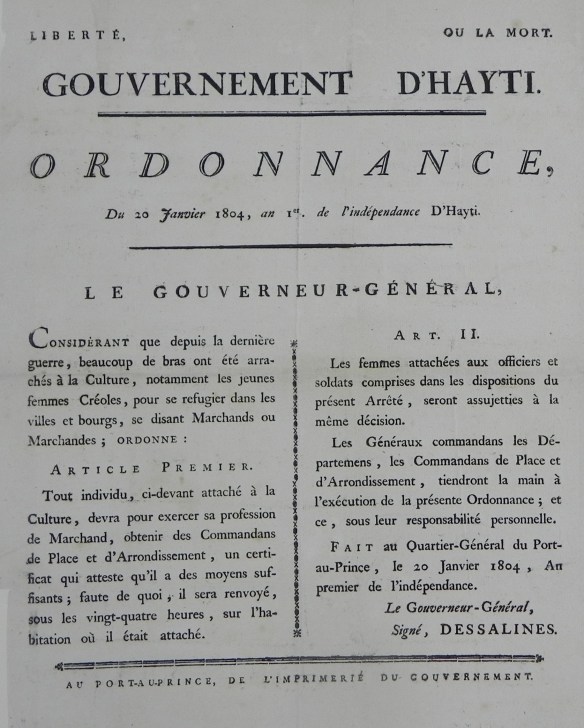
Post-independence Labor and Migration Restrictions

This Ordinance is cataloged with the broadside version of the Declaration of Independence and it sheds light on some of the post-independence restrictions on mobility and plantation labor.

DSCN0611

Continue reading

English Translation of the HaitiDOI

I found this translation of the Haitian Declaration of Independence in the Admiralty Records from the Jamaica Station (ADM 1/254) (it was next to the paper that noted that the broadside copy had been removed and recataloged). I think it’s interesting to read translations like this because it reveals how contemporaries interpreted the text. One interesting translation is of the word “lugubre” that Dessalines and Boisrond-Tonnerre use as a verb in the Declaration of Independence. This translator uses the word “overclouds” although historians have used “haunts,” “overshadows,” or “darkens” (and I’m sure other variations too). Here is the first page along with my transcription of the text.

DSCN0572

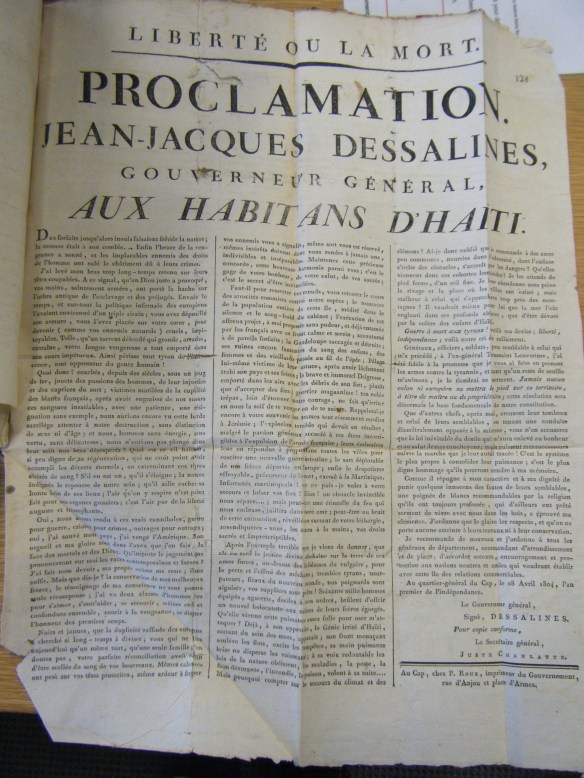
I Have Avenged America

The Haitian Declaration of Independence is characterized by violent rhetoric that brands the French as the eternal enemies of the Haiti. The Declaration also signals that the war against the French is not over since the “the name French overclouds our Country.” To help remedy this barrier obstructing the development of the new nation, Dessalines initiated a series of public executions that targeted white French citizens. The well-known “I have avenged America” speech followed these executions and justified the events. This is a printed copy of the document from The National Archives of the United Kingdom (CO 137-111) and a transcription of a translation of the text from the Connecticut Herald.

DSCF9464

Continue reading

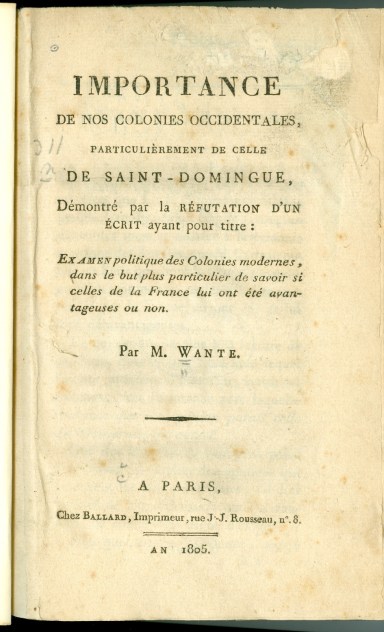
European Imports from the Colonies, 1789

This table comes from an 1805 publication in Paris by M. Wante called Importance de nos colonies occidentales, particulièrement de celle de Saint-Domingue.scan0001

Continue reading

Plan of Attack on Caracol, 1803

I first saw this map in 2008 when I took my first research trip to Paris. It is at the Richelieu branch of the Bibliotheque Nationale (you can also see it online at Gallica). This is one of those sources that doesn’t really fit with my research project, but I really like it anyway. The watercolor painting is just beautiful! Does anyone know about this battle? Or if it even happened (the painting might be a hypothetical!).

20130331-152022.jpg

Swa Nou Viv Lib Swa Nou Mouri, Jacques Pierre’s translation of the DOI

In the 2011 issue of the Journal of Haitian Studies, Duke Professor Jacques Pierre published a Kreyol translation of the Acte d’Indépendance. Jacques has been working hard to change the historic tendency in Haiti to favor French over Kreyol (see, for example, his op-ed in The Haitian Times).

Continue reading